From Editor: James Cawley
NASA and SpaceX once again are gearing up to launch crew on an American rocket and spacecraft to the International Space Station to perform science, technology demonstrations, and maintenance activities aboard the microgravity laboratory.
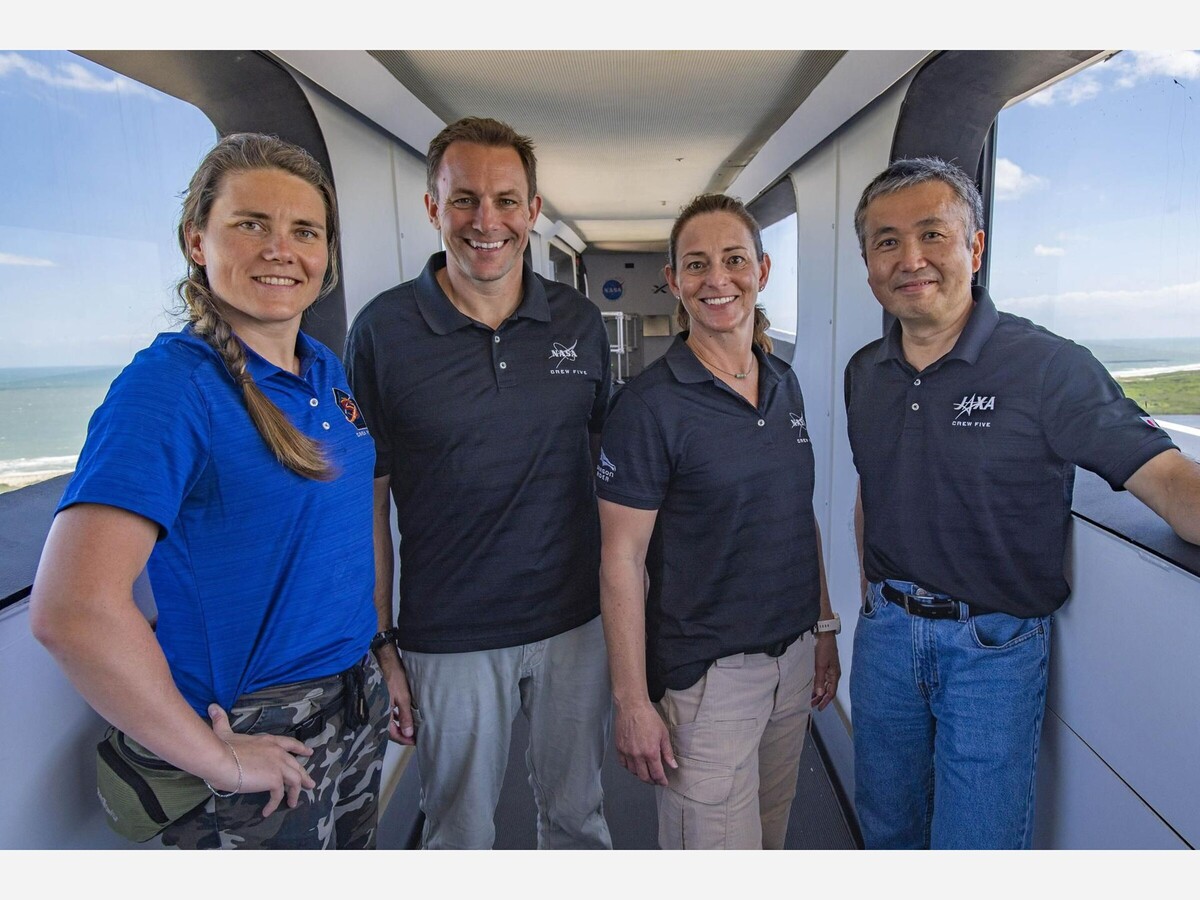
NASA’s SpaceX Crew-5 will launch astronauts Nicole Mann and Josh Cassada of NASA, astronaut Koichi Wakata of JAXA (Japan Aerospace Exploration Agency), and cosmonaut Anna Kikina of Roscosmos, from Launch Complex 39A at NASA’s Kennedy Space Center in Florida.
The international crew of four will fly aboard the SpaceX Dragon Endurance spacecraft and will launch on a new Falcon 9 booster to the orbiting laboratory to spend up to six months at the space station before returning to Earth.
The flight is the fifth crew rotation mission with SpaceX to station, and the sixth flight of Dragon with people as part of NASA’s Commercial Crew Program.
The Crew
This will be Mann’s first spaceflight since becoming an astronaut in 2013. As mission commander, she will be responsible for all phases of flight, from launch to re-entry. She will serve as an Expedition 68 flight engineer aboard the station.
Mann was born in Petaluma, California, and will be the first indigenous woman from NASA in space. She earned a bachelor’s degree in mechanical engineering from the United States Naval Academy and a master’s degree in mechanical engineering with a specialty in fluid mechanics from Stanford University. She is a colonel in the U.S. Marine Corps and served as a test pilot in the F/A-18 Hornet and Super Hornet.
This will also be Cassada’s first flight since his selection as an astronaut in 2013. As pilot, he will be responsible for spacecraft systems and performance. Aboard the station, he will serve as an Expedition 68 flight engineer.
Cassada grew up in White Bear Lake, Minnesota, and is a physicist and U.S. Navy test pilot. Prior to becoming a naval aviator, Cassada earned a bachelor’s degree in physics at Albion College and a doctorate at the University of Rochester, conducting experimental high energy physics research at Fermi National Accelerator Laboratory.
Wakata will be making his fifth trip to space and as a mission specialist he will work closely with the commander and pilot to monitor the spacecraft during the dynamic launch and re-entry phases of flight. Once aboard the station, he will be a flight engineer for Expedition 68. With Crew-5’s launch, Dragon will be the third different type of spacecraft that Wakata has flown to space.
Kikina will be making her first trip to space, and will serve as a mission specialist, working to monitor the spacecraft during the dynamic launch and re-entry phases of flight. She will be a flight engineer for Expedition 68.
Mission Overview
Lifting off from Launch Pad 39A on a Falcon 9 rocket, Dragon Endurance will accelerate its four passengers to approximately 17,500 mph, putting it on an intercept course with the International Space Station.
Once in orbit, the crew and SpaceX mission control in Hawthorne, California, will monitor a series of automatic maneuvers that will guide Crew-5 to the forward end of the station’s Harmony module. After several maneuvers to gradually raise its orbit, Endurance will be in position to rendezvous and dock with its new home in orbit. The spacecraft is designed to dock autonomously, but the crew can take control and pilot manually, if necessary.
After docking, Crew-5 will be welcomed inside the station by the seven-member crew of Expedition 68. The astronauts of NASA's SpaceX Crew-4 mission will undock from the space station and splash down off the coast of Florida several days after Crew-5's arrival.
Crew-5 will conduct new and exciting scientific research in areas including cardiac to prepare for human exploration beyond low-Earth orbit and benefit life on Earth.
Experiments will include studies on printing human organs in space, understanding fuel systems operating on the Moon, and better understanding heart disease. These are just some of the more than 200 science experiments and technology demonstrations that will take place during their mission.
- The BioFabrication Facility (BFF) is a steppingstone in a long-term plan to manufacture whole human organs in space. In 2019, it arrived at the space station, where it successfully printed a partial human knee meniscus and a large volume of human heart cells. It returned to Earth in 2020 for maintenance and upgrades, including new temperature-controlled printheads that will allow the use of bioink formulations that were not possible in the previous BFF configuration. The BFF will return to the space station in the fall of 2022, and will continue testing the in-orbit manufacture of cardiac and orthopedic tissue and start a new program aimed at testing the manufacturing of vasculature in space.
- As we design space systems such as lunar rovers, life support systems, and fuel tanks to support future exploration missions, it is critical to understand and be able to predict how liquids behave in low gravity environments. The Liquid Behavior investigation will study how liquids move in a container in simulated lunar gravity to generate data that can be used to improve lunar rover designs.
- Heart disease is the number one cause of death in the United States. Heart stem cells could provide a sustainable source of cells to treat heart disease, and to act as a cell source for drug discovery and safety testing back on Earth. Microgravity may hold the key to increasing stem cell production, improving cell viability, and accelerating the maturation of heart stem cells. The Project EAGLE investigation will study how spaceflight affects properties of heart muscle cells derived from stem cells in an aim to establish a functional heart tissue model that mimics heart disease and can be used to test new drugs.
During their stay aboard the orbiting laboratory, Crew-5 will see the arrival of cargo spacecraft including the SpaceX Dragon and the Northrop Grumman Cygnus in the fall.
At the conclusion of the mission, Dragon Endurance will autonomously undock with the four crew members aboard, depart the space station and re-enter Earth’s atmosphere. After splashdown just off Florida’s coast, a SpaceX recovery vessel will pick up the crew and bring it back to shore.
Commercial crew missions enable NASA to maximize use of the International Space Station, where astronauts have lived and worked continuously for more than 21 years testing technologies, performing science, and developing the skills needed to operate future commercial destinations in low-Earth orbit and explore farther from Earth. With Artemis, NASA will send astronauts to the Moon to prepare for future human exploration of Mars. Inspiring the next generation of explorers – the Artemis Generation – ensures America will continue to lead in space exploration and discovery.
More News from Raritan

 80° and Sunny